
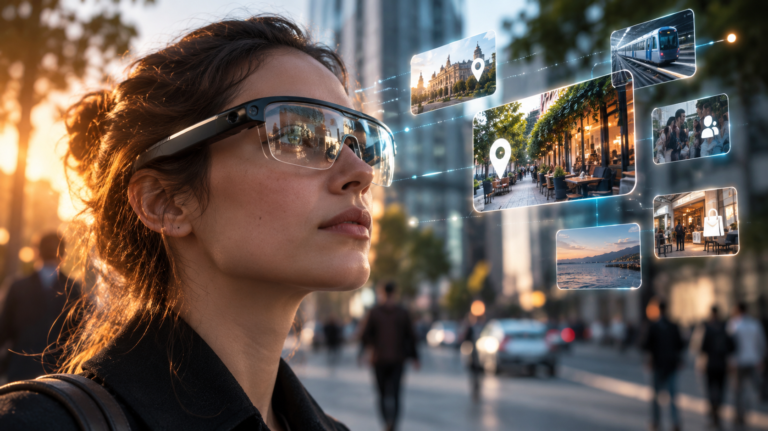
Smart glasses may look like a hardware category, but the larger business opportunity sits somewhere else.
The frames matter. So do the cameras, displays, speakers and batteries. But if smart glasses become a meaningful way of accessing digital services, the companies that control the smart glasses ecosystem could occupy a position much more valuable than simply selling another device.
They may control the assistant that answers the user’s questions, the software developers build on, the services that can be called, the apps that are discovered and the interface through which people interact with the digital world.
That is why the emerging competition between companies such as Meta and Google is not only a race to build better glasses.
It is a race to define who sits between the user and the next generation of computing.
Smart glasses are becoming a platform, not just a product
The smartphone industry demonstrated how valuable control of an interface can become.
Hardware created the device, but operating systems, app stores, payment systems, developer tools and digital services created much of the ecosystem surrounding it.
Smart glasses are beginning to move in a similar direction.
Google describes Android XR as an extension of the Android platform designed to support headsets, wired XR glasses, audio glasses and display glasses. Developers can build through an Android XR SDK, while Google is actively supporting developer projects across areas including navigation, commerce, productivity and social experiences.
Meta is also opening its glasses beyond first-party functionality. Its wearable developer platform now offers multiple routes: existing mobile apps can connect to glasses through the Wearables Device Access Toolkit, developers can build web apps for display glasses, and services can connect directly to Meta AI through new AI connectors.
That changes the business model.
A pair of glasses stops being only something a company sells once. It can become a platform through which other companies reach the user.
Meta and Google are approaching the market from different positions
The two most visible ecosystems currently reflect different strategic strengths.
Meta has spent years building directly around consumer eyewear. Its long-term partnership with EssilorLuxottica extends into the next decade and combines Meta’s technology with an enormous eyewear, retail and brand infrastructure. The partnership now spans Ray-Ban Meta, Oakley Meta, prescription-focused designs, Meta-branded glasses and display models.
By September 2026, Meta and EssilorLuxottica said their combined portfolio was on track to exceed 100 AI-glasses styles by the end of the year.
Google’s advantage is different.
Rather than building the eyewear category around one vertically coordinated brand partnership, it is positioning Android XR as a broader platform. The system was developed with Samsung and Qualcomm, while upcoming intelligent eyewear involves established fashion and eyewear names such as Warby Parker and Gentle Monster. Google’s first audio glasses are due in fall 2026, with Gemini providing the AI layer.
One strategy begins with a strong consumer product and expands outward.
The other begins with an existing software ecosystem and attempts to extend it into a new class of devices.
The AI assistant may become more valuable than the operating system
Smartphones trained users to think in terms of apps.
Wearable AI may shift some of that power toward the assistant.
If a user can simply ask their glasses to find a restaurant, send a message, identify something they are looking at or interact with a service, they may never consciously decide which application should handle every step.
The assistant can increasingly make that connection for them.
Google is placing Gemini at the centre of Android XR intelligent eyewear, with capabilities including visual questions, navigation, messaging, translation and interactions with connected services.
Meta is following the same broader logic. At Connect 2026, it announced that its Muse personal AI agent would come to AI glasses, making the assistant a persistent interface across the day.
This potentially changes where platform power sits.
On smartphones, owning the operating system and app store has been critical. On AI glasses, owning the assistant that decides which service should answer may become equally strategic.
Developers are becoming the next battlefield
A platform cannot scale only through first-party features.
It needs developers.
That is why the most important smart-glasses announcements are increasingly happening not only at hardware launches but inside developer ecosystems.
Google has created an Android XR Developer Catalyst Program with hardware access, technical resources and potential funding for teams building experiences across areas such as navigation, entertainment, productivity, health and commerce.
Meta has moved even further toward opening its current consumer glasses. As of September 30, 2026, Wearables Device Access Toolkit 1.0 is beginning its rollout after a year in developer preview. The toolkit lets existing iOS and Android apps access supported glasses capabilities such as cameras, microphones, audio, motion and, on compatible models, displays and inputs.
That date is important because it moves the category from experimentation toward something closer to a supported developer platform.
The battle for smart glasses will therefore not be decided only by which company builds the best camera or the lightest frame.
It will also depend on where developers believe their time is worth investing.
Meta is trying to reduce the cost of joining its ecosystem
One of Meta’s more interesting strategic choices is that developers do not always have to build a new standalone “glasses app”.
The Device Access Toolkit is designed to extend an existing mobile application onto smart glasses while allowing the developer to retain the current mobile codebase, infrastructure and app-store listing. Meta is also allowing standalone web experiences on compatible display glasses and experimenting with connectors that let services expose actions directly to Meta AI.
From a business perspective, this reduces an obvious adoption problem.
Developers are reluctant to invest heavily in a new platform before it has enough users, while users are reluctant to adopt a new platform without enough useful services.
Allowing companies to extend products they already operate can make the transition less expensive.
Instead of asking every business to build “an app for glasses”, Meta can ask:
What part of the service you already have becomes useful when the customer is hands-free?
Google can reuse the scale of Android
Google has a different way to attack the same chicken-and-egg problem.
Android XR builds on technologies already familiar to Android developers. Google describes it as an extension of the Android ecosystem and provides Android Studio, Android APIs, emulators and XR-specific libraries for developers building across different form factors.
That existing developer base is strategically significant.
A new computing platform normally has to convince developers to learn unfamiliar tools while simultaneously proving that an audience exists.
Google can instead attempt to extend an ecosystem developers already know.
That does not guarantee adoption. The interaction model for glasses is fundamentally different from a phone, and distribution for audio and display-glasses experiences is still evolving. Google currently notes that conventional Google Play distribution is available for headsets and wired XR glasses, while distribution mechanisms for augmented experiences on audio and display glasses are still developing.
But Android gives Google a large foundation from which to start.
App discovery could become a major source of platform power
Building an experience is only one part of an ecosystem.
Users also need to discover it.
This is where smart glasses begin to resemble earlier platform battles.
Meta has already announced new discovery surfaces for glasses experiences. Its Meta AI app can act as a catalog where users browse and manage compatible experiences, while Meta Ray-Ban Display includes an Explore surface for selected web apps.
That may look small compared with a mature mobile app store, but the underlying business issue is familiar.
Who determines what gets featured?
How are developers discovered?
Which services become defaults?
How does distribution work?
If wearable computing grows, controlling these discovery surfaces could become increasingly valuable because the platform does not merely host software.
It helps determine which services reach the user’s attention.
Eyewear companies have more leverage than traditional electronics suppliers
There is another unusual player in this market: the eyewear industry itself.
A technology company can design excellent electronics and still fail if consumers do not want to wear the result.
EssilorLuxottica brings Meta something that would be difficult to recreate quickly: eyewear design expertise, recognised brands, prescription capabilities and a large retail and wholesale network. The companies explicitly describe their partnership as combining Meta’s technology with EssilorLuxottica’s manufacturing, design and distribution strengths.
Google is also treating eyewear companies as strategic partners rather than simply frame suppliers, working with Warby Parker and Gentle Monster alongside Samsung.
This makes smart glasses different from smartphones.
Fashion, fit, optical requirements and physical retail are much more central to the product.
Control of the ecosystem may therefore need to be shared across technology and eyewear companies rather than concentrated entirely inside Silicon Valley.
Distribution could be as important as software
Smartphones are usually purchased as electronics.
Glasses often are not.
Consumers try them on. They need adjustments. Some require prescription lenses. Fit and style can influence the purchase as much as specifications.
That gives physical distribution unusual strategic importance.
EssilorLuxottica’s global network is one of the key assets behind Meta’s approach, while the expansion into prescription-focused products and more than 100 styles shows that the category is increasingly being treated like eyewear rather than a single gadget line.
The winning smart-glasses ecosystem may therefore need to succeed simultaneously in two worlds:
software distribution and physical eyewear distribution.
Very few technology categories require both at this scale.
The customer relationship is the real prize
From a business perspective, selling hardware may eventually be only one part of the opportunity.
The more valuable position is potentially owning the point at which the user asks for something.
If someone says:
“Where should I eat?”
“Translate this.”
“Take me there.”
“Order my usual coffee.”
“Message them.”
the platform handling those requests sits very close to commercial intent.
This connects directly with the marketing shift examined in the published Targeted.gr article, “When the Screen Moves to Your Face: What AI Glasses Could Change for Marketing” Smart glasses could shorten the path between physical context, digital discovery and action.
For the platform company, however, the strategic question goes deeper.
Who gets to mediate that action?
If an assistant chooses which service to call, which result to surface or which integration can complete the task, then controlling the interface becomes economically significant even when the user never sees a traditional app screen.
Smart glasses could redistribute power away from individual apps
The smartphone economy trained businesses to compete for app downloads, home-screen placement and notifications.
AI-first interfaces may make some of those advantages less important.
A user may not care which app technically performs a task if the assistant can complete it through conversation.
Meta’s new AI Connectors illustrate this direction. Developers can expose services to Meta AI so that the assistant can invoke them without requiring the user to leave the conversation and manually navigate a separate interface.
This does not mean apps disappear.
They remain important for account management, richer interfaces and complicated tasks.
But their role may shift from always being the destination to sometimes being the infrastructure behind an AI interaction.
That could change the economics of digital distribution substantially.
Open ecosystems and controlled experiences create a familiar tension
Platforms usually face a trade-off.
More openness attracts developers and expands capabilities.
More control can improve consistency, safety and user experience.
Smart glasses will face the same tension, perhaps more strongly because the device contains cameras, microphones, personal context and potentially always-available AI.
Meta is opening more of its hardware capabilities to developers, but discovery experiences are initially curated and capabilities depend on permissions and supported devices.
Google similarly provides an open Android-oriented development path while still defining platform APIs, distribution mechanisms and Gemini integration.
The commercial question will be how much freedom each ecosystem offers developers without losing control of the experience closest to the user.
Hardware margins may not be the only economics that matter
It is tempting to analyse smart glasses like any other consumer-electronics category.
How many units are sold?
What is the average selling price?
What does the hardware cost?
Those metrics matter, but a mature ecosystem could create value elsewhere.
Developer distribution, AI services, app transactions, commerce integrations, subscriptions, advertising and data-driven services could eventually become part of the economic model.
Not all of these models exist at meaningful scale today, and it would be premature to assume exactly how monetisation will develop.
The important point is structural.
If glasses become an interface rather than merely an accessory, the economic value can extend far beyond the margin on the frame itself.
The category also creates a dependency problem for businesses
A new interface creates opportunity, but it also creates another platform businesses may need to depend on.
A restaurant may depend on how Google’s assistant interprets its information.
A fitness company may build a wearable experience using Meta’s device APIs.
A navigation service may adapt to Android XR.
A retailer may eventually expose actions to multiple AI assistants.
Each additional ecosystem creates integration costs, platform rules and strategic dependencies.
This is the kind of market transition frequently examined by Market Insiders: technological convenience for the user often creates new coordination and dependency costs behind the scenes for businesses.
If smart glasses grow, companies may eventually face a familiar question from the mobile era:
Do we build for one ecosystem first, or try to support all of them?
Meta currently has the advantage of products already on faces
Meta’s position is strengthened by the fact that its smart-glasses ecosystem is not purely theoretical.
Meta and EssilorLuxottica say millions of consumers are already wearing glasses from their AI portfolio, while the range now spans Ray-Ban, Oakley, Meta-branded products and display glasses.
This provides Meta with something valuable: actual behavioural data about how people use the form factor and an installed base that developers can potentially target.
The company is now layering a broader developer ecosystem on top of that hardware adoption.
That sequencing matters.
Meta first established a consumer product and is increasingly turning it into a platform.
Google brings a much larger existing software ecosystem
Google’s position is almost the reverse.
Its new consumer intelligent eyewear is only beginning to reach the market, but Android, Gemini, Maps, messaging, Google Play and the broader Android developer ecosystem already exist at enormous scale.
Android XR therefore does not start from zero as a software platform.
Google is attempting to extend assets it already controls into a new form factor.
This may make the emerging smart-glasses market less like a conventional product battle and more like a collision between two different forms of ecosystem strength:
Meta brings established smart-eyewear adoption and deep eyewear partnerships.
Google brings an enormous operating-system, AI and developer infrastructure.
Neither advantage automatically determines the outcome.
The winner may not be a single company
It is also possible that thinking in terms of one winner is the wrong framework.
Eyewear is inherently fragmented by style, prescription, geography and use case.
Consumers may use one ecosystem for sports glasses, another for everyday prescription eyewear and another for richer display experiences.
Developers may build integrations that span several platforms.
AI services themselves may eventually become interoperable across devices.
What matters is that several companies are now attempting to establish positions at different layers of the stack:
frames, hardware, operating systems, AI assistants, apps, developer tools and distribution.
The strategic value lies in controlling enough of those layers to shape the customer relationship.
The technology is starting to feel normal, which makes the business question more important
The published Athens Pulse article “Why Smart Glasses Are Starting to Feel Normal” examined the consumer side of this transition: lighter designs, familiar eyewear brands, audio-first interaction and AI are reducing the distance between smart glasses and everyday behaviour.
That normalisation is exactly what makes the ecosystem battle more important.
A strange experimental device can remain a niche hardware category.
A pair of glasses worn throughout the day can become an interface.
And interfaces have historically been among the most strategically valuable positions in technology.
The next question is what users can actually do today
The platform ambitions are large, but consumers still encounter individual products rather than ecosystems.
Some smart glasses provide audio and AI but no display. Others include cameras. Display models can offer navigation or glanceable information, while many experiences still depend heavily on a connected smartphone.
The forthcoming Techrow.gr article, “Smart Glasses in 2026: What They Can Actually Do Right Now” will close the cluster from that practical perspective, separating the platform vision from the capabilities consumers can actually use today.
The next interface is valuable because it can become invisible
The biggest strategic advantage of smart glasses may ultimately be that users do not need to consciously “enter” the platform every time they use it.
A smartphone requires someone to pick it up and look at the screen.
Glasses are already there.
If the user can ask a question, receive navigation, communicate, capture something or call a service without interrupting what they are doing, the interface becomes woven more deeply into daily behaviour.
That creates enormous potential value for whichever companies control the systems underneath it.
The smart-glasses market therefore is not simply a competition to build the best-looking frames.
It is becoming a competition over who owns the AI, software, developers, distribution and services behind the frames.
The hardware is what the user wears.
The ecosystem is where much of the business may eventually be built.
Frequently Asked Questions
What is the smart glasses ecosystem?
It includes the hardware, eyewear manufacturers, AI assistants, operating platforms, developer tools, applications, services and distribution channels that work together around smart glasses.
Is Meta building a developer platform for smart glasses?
Yes. Meta offers the Wearables Device Access Toolkit, web apps for compatible display glasses and Meta AI Connectors. Wearables Device Access Toolkit 1.0 begins rolling out on September 30, 2026.
What is Android XR?
Android XR is Google’s platform for multiple XR device categories, including headsets, wired XR glasses, audio glasses and display glasses. It is being developed with partners including Samsung and Qualcomm.
Who is making Google’s smart glasses?
Google is working with Samsung and eyewear companies including Warby Parker and Gentle Monster on intelligent eyewear, with the first audio models expected in fall 2026.
Who makes Meta’s smart glasses?
Meta works closely with EssilorLuxottica, whose portfolio includes brands such as Ray-Ban and Oakley. Their long-term smart-eyewear partnership extends into the next decade.
Why do developers matter to smart glasses?
Third-party developers expand what the devices can do. Both Meta and Google are building tools and programs intended to help developers create experiences for wearable form factors.
Will apps disappear if AI assistants become the main interface?
There is no evidence that apps are disappearing. A more plausible shift is that some services may increasingly be accessed through assistants or wearable interfaces without requiring users to open the full application manually.
Why does control of the smart-glasses interface matter?
A company controlling the interface can influence how users access information, discover services and interact with third-party applications. If smart glasses achieve wider adoption, that position could become strategically important in much the same way other computing platforms have been.