
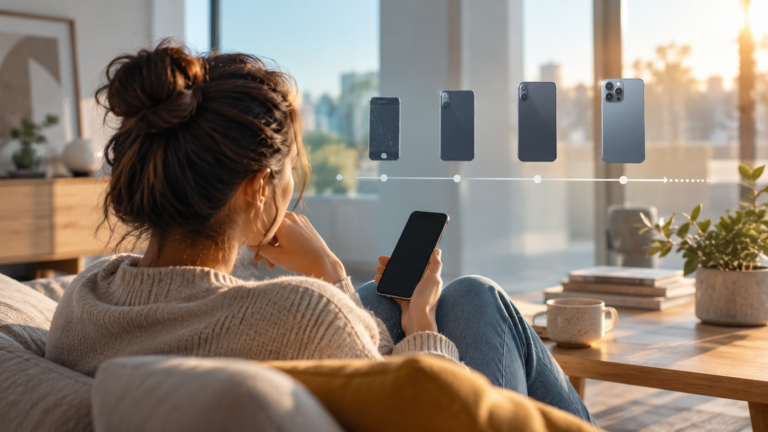
A company can have more customers, more active devices and stronger loyalty while still facing a difficult commercial problem: those customers may simply be buying less often.
That is increasingly relevant in the smartphone market, where replacement cycles have moved close to four years. Devices remain capable for longer, software support has improved and higher prices give consumers another reason to postpone replacement.
For Market Insiders, the interesting question is therefore not why people keep their phones longer, but what happens to a business model when the customer remains satisfied while the next hardware transaction moves further into the future.
This is the replacement cycle problem.
A satisfied customer can become a less frequent customer
Most businesses naturally want customers to remain satisfied with their products.
Smartphones create an unusual tension because greater satisfaction can also reduce the urgency to purchase again. If a device remains fast, secure and useful for four years instead of two, the customer relationship may be healthy while hardware purchase frequency falls sharply.
That makes satisfaction and transaction frequency increasingly separate metrics.
A customer who does not upgrade may not be disengaged. The product may simply be working too well to replace.
Small changes in replacement timing can have large effects
The difference between replacing a smartphone every two years and every four years sounds simple, but economically it is substantial.
Over an eight-year relationship, a two-year cycle could theoretically generate four replacement events. A four-year cycle reduces that to two.
Real customer behaviour is obviously more complex, but the principle illustrates why replacement timing matters so much for hardware businesses. Even modest extensions across millions of users can materially change annual unit demand.
The installed base may remain large while the number of customers entering the market each year becomes smaller.
The installed base and annual sales start telling different stories
A growing installed base is usually positive because it represents more people using the company’s products.
But installed base growth does not automatically translate into equivalent hardware growth.
If devices remain active for longer, the number of products in use can rise even while annual replacement demand slows. Second-hand and refurbished devices can extend that divergence further by keeping hardware active after the original owner has moved on.
Businesses therefore need to distinguish between how many customers are inside the ecosystem and how many are currently generating a hardware transaction.
Those are increasingly different questions.
Forecasting becomes harder
Replacement-driven markets depend heavily on predicting when existing customers will return.
When ownership cycles were relatively stable, historical replacement patterns offered a stronger basis for forecasting. Longer and more variable ownership makes that process harder.
Battery health, repair decisions, device prices, software support, economic conditions, trade-in values and new product features can all influence when an individual customer finally replaces a phone.
For manufacturers, retailers and carriers, a longer cycle therefore creates more uncertainty around when installed demand converts into actual sales.
A delayed purchase is not always a lost purchase
This distinction matters.
When a consumer decides not to replace a three-year-old smartphone this year, the sale may not disappear permanently. It may simply move into next year.
For forecasting purposes, however, that delay still matters.
Revenue expected in one period moves into another, production assumptions can become less accurate and inventory planning becomes more difficult. Across millions of customers, repeated delays can reshape an entire annual sales cycle.
The replacement cycle problem is therefore partly about timing revenue correctly, not simply about whether the revenue exists at all.
Hardware businesses become more exposed to replacement waves
Long ownership periods can also create more pronounced cohorts.
Large groups of customers who purchased devices during the same strong product cycle may eventually approach replacement at similar times. Conversely, a weak upgrade generation can push that demand forward again.
This creates the possibility of irregular replacement waves rather than a consistently predictable annual market.
A company may therefore experience periods of strong demand followed by quieter years without necessarily gaining or losing the same proportion of customers.
That can make short-term performance more difficult to interpret.
Revenue growth becomes less connected to user growth
In a rapidly expanding market, acquiring more users can naturally produce more device sales.
In a mature market, the relationship becomes weaker.
A company can increase its active user base through customer retention, second-hand devices and longer device lifespans without seeing equivalent growth in annual hardware shipments.
That means management can no longer treat installed-base growth as a direct proxy for hardware revenue growth.
The economic question becomes how much value each active user generates throughout the ownership period, not simply how many active devices exist.
Recurring services become strategically more important
This is where services enter the equation.
If the customer purchases hardware less frequently, recurring revenue generated between those purchases becomes more valuable.
Cloud storage, device protection, payments, subscriptions, content services, AI features and other ecosystem products can create commercial activity even when the smartphone itself remains unchanged.
The hardware transaction becomes one part of a longer revenue relationship rather than the only meaningful moment.
For companies with large installed bases, that can reduce dependence on replacement frequency.
The installed base becomes an economic asset
A large installed base therefore has value beyond future smartphone replacements.
Every active device can represent a customer who may subscribe to a service, purchase accessories, use payments, buy another ecosystem product or eventually trade the device in for something newer.
This changes the way businesses can think about hardware.
The smartphone is not only a unit sold. It can also function as an entry point into years of additional transactions.
That makes the quality and monetisation of the installed base increasingly important.
Hardware margins and ecosystem margins become connected
Longer ownership can also change where profit is generated.
A company may earn less frequently from smartphone replacements but continue generating margin from services, accessories and adjacent devices.
That makes ecosystem design more than a retention strategy. It becomes part of the revenue architecture.
The stronger the relationship between the smartphone and the wider ecosystem, the less dependent total customer value becomes on replacing the phone itself every few years.
The business therefore shifts from asking “How often will this customer buy another device?” toward “What can this customer generate throughout the entire relationship?”
Premiumisation can offset some of the volume pressure
Slower replacement does not automatically mean lower revenue.
Customers who replace devices less frequently may be willing to spend more when they finally do, particularly if they expect the next purchase to last several years.
That creates room for premiumisation.
Higher average selling prices can partly compensate for lower unit frequency, although the trade-off has limits. If prices rise too far, customers may extend ownership even further or move toward refurbished devices.
The company therefore has to balance higher value per transaction against lower transaction frequency.
The revenue mix becomes more important than unit sales alone
In this environment, shipment volume tells only part of the story.
A business may sell fewer smartphones while increasing average selling prices, service revenue or accessory revenue. Another may maintain unit volume but struggle to monetise its installed base.
Evaluating performance therefore requires looking beyond raw shipments.
Revenue mix, margins, recurring revenue, active users and customer lifetime value can become increasingly important alongside hardware units.
The replacement cycle problem is ultimately a business-model problem, not simply a sales-volume problem.
Repairs complicate the economics further
Repair can delay a replacement, but it can also preserve a customer relationship.
A new battery or screen may extend the device’s useful life by another year or more, apparently pushing hardware revenue further into the future.
At the same time, repair services can generate revenue, protect customer satisfaction and reduce the risk that a broken device sends the customer to another brand.
The economic impact therefore depends on the entire lifecycle.
A delayed replacement may be commercially acceptable if the company continues capturing value during the extended ownership period.
Refurbished devices create both competition and opportunity
Refurbished smartphones complicate the picture even further.
A used premium device can compete directly with a new mid-range model, potentially reducing new-device demand. But that same refurbished phone can also bring another customer into the ecosystem.
The device can therefore generate economic value across multiple owners.
This makes second-life hardware difficult to classify simply as lost new-device revenue. Its real impact depends on whether the company can continue monetising the new owner through services, accessories and eventual replacement.
Trade-ins help businesses manage the replacement cycle
Trade-ins can shorten the gap between interest and replacement by giving the customer’s existing device a clear economic value.
They also help companies recover hardware that can be refurbished, resold or recycled.
That creates a more circular commercial model in which the old device becomes part of the economics of the new transaction.
Trade-ins therefore affect more than marketing. They influence inventory, pricing, refurbishment supply and the timing of replacement demand.
Inventory planning becomes more sensitive
When customers upgrade less predictably, inventory decisions become harder.
Manufacturers and retailers still need to estimate demand before knowing exactly how many existing owners will decide that this year’s model finally justifies replacement.
Overestimating demand can create excess inventory and discounting pressure. Underestimating it can produce shortages during a stronger-than-expected replacement wave.
A longer and less uniform replacement cycle therefore increases the importance of flexible supply chains and more accurate demand signals.
The cost structure still runs every year
There is another important imbalance.
Customers may stop following the annual replacement cycle, but much of the industry continues operating annually.
New product development continues.
Marketing campaigns continue.
Retail distribution continues.
Manufacturing preparation continues.
Launch events continue.
A company therefore continues carrying the cost of annual innovation even when a growing share of customers chooses not to participate in every cycle.
That makes the economics of each generation more demanding.
Innovation has to justify its commercial cost
When customers upgrade frequently, incremental improvements can still generate significant replacement demand.
When customers wait four years, several generations of incremental innovation may effectively be combined into one eventual purchase.
This raises a difficult strategic question: how much annual R&D is commercially justified if customers increasingly experience innovation cumulatively rather than generation by generation?
That does not mean companies can simply stop innovating. Competitive markets punish stagnation.
But it does mean the connection between annual innovation spending and annual replacement revenue becomes less direct.
The customer lifetime becomes more important than the product cycle
The traditional smartphone industry revolves around annual product generations.
The business increasingly needs to think in terms of customer lifetimes instead.
A single customer may remain in the ecosystem across several generations without buying each one. During that time, they can generate service revenue, purchase accessories, recommend the brand and eventually return for another premium device.
The meaningful economic unit therefore becomes less one product launch and more the complete customer relationship across multiple launches.
Customer lifetime value becomes a central metric
This makes customer lifetime value increasingly useful.
A customer who buys a €1,200 phone every four years, pays for cloud storage, owns a smartwatch and eventually upgrades within the same ecosystem may be considerably more valuable than someone who replaces hardware more often but buys lower-margin devices and no services.
Purchase frequency alone therefore provides an incomplete picture.
The relevant question becomes how much economic value the company can create across the customer’s entire time inside the ecosystem.
Longer replacement cycles can reward strong ecosystems
Companies with broader ecosystems may be better positioned to tolerate slower smartphone replacement because they have more ways to monetise the period between purchases.
Hardware companies dependent primarily on the next device sale face a different challenge.
That does not automatically make one model superior, but it changes exposure to the replacement cycle problem.
The longer customers keep the core product, the more valuable additional revenue streams can become.
The replacement cycle can become a capital-allocation question
Longer ownership also affects where businesses choose to invest.
Should more resources go toward acquiring new users?
Toward services?
Trade-in infrastructure?
Repair networks?
Refurbishment?
Premium hardware?
Accessories?
The answer depends partly on how frequently customers are realistically going to replace the core product.
As replacement slows, companies may need to allocate more capital toward increasing the value of the installed base rather than assuming that hardware frequency will eventually return to previous levels.
Growth can look different in a mature hardware market
A mature smartphone company may eventually grow without selling dramatically more smartphones.
Growth can come from higher-value devices, more services, ecosystem expansion, better retention or monetising customers who already own the hardware.
That requires a different interpretation of scale.
A business with hundreds of millions of active devices already has an enormous customer base. The challenge becomes extracting sustainable value without needing every customer to buy the core product again each year.
The marketing response has already started changing
The Targeted.gr article “Marketing Beyond the Upgrade: How Brands Sell When Customers Keep Devices Longer” explored the marketing side of this shift: trade-ins, lifecycle communication, retention, services and the need to make upgrades meaningful rather than automatic.
The business consequence is broader.
Marketing can improve conversion when a customer finally becomes ready to upgrade, but it cannot completely eliminate longer replacement cycles.
Businesses therefore need revenue structures capable of functioning even when customers remain satisfied with existing hardware for years.
Consumer behaviour sits underneath the business problem
The shift begins with a relatively simple consumer behaviour change.
As explored in the Athens Pulse article “Why People Are Keeping Their Phones for Longer” modern smartphones remain useful for longer because improvements have become more incremental, software support has expanded and replacement is increasingly based on individual needs rather than the calendar.
From a business perspective, however, millions of individual decisions to keep a device for another year become a major economic variable.
What feels like a small personal decision can become a significant change in market demand when repeated across the entire installed base.
The practical upgrade decision completes the picture
There is also a practical side to the same cycle.
The forthcoming Techrow.gr article “Do You Really Need a New Phone? How to Know When It Is Actually Time to Upgrade” will examine when battery condition, security support, performance, storage or repair costs actually make replacement worthwhile.
That customer-level decision ultimately determines when installed-base potential converts back into hardware revenue.
For the business, the challenge is that the answer increasingly belongs to the customer rather than the annual launch calendar.
The replacement cycle problem is really a timing problem
Customers have not stopped needing smartphones.
Nor have they stopped buying them.
The fundamental change is how often the transaction occurs.
When that interval expands, revenue arrives later, forecasts become less predictable and companies need more ways to create value during the years between purchases.
That is why the replacement cycle problem matters even when the underlying market remains enormous.
The strongest business may not need the customer to upgrade quickly
There is a paradox at the centre of the smartphone industry.
A company wants to build a product good enough that customers remain satisfied for years, but doing that can reduce the frequency with which those same customers buy another one.
The businesses best adapted to longer replacement cycles may therefore be those that do not depend entirely on shortening them.
Instead, they can create value from the full installed base through services, accessories, repairs, trade-ins, premium hardware and long-term ecosystem relationships.
The replacement cycle problem does not necessarily mean customers are disappearing.
It means the economic value of those customers has to be captured differently.
Frequently Asked Questions
What is the replacement cycle problem?
The replacement cycle problem occurs when customers keep products for longer, reducing the frequency of new purchases even though the existing customer base remains large and satisfied.
Why do longer smartphone replacement cycles matter for businesses?
Longer cycles can reduce annual hardware demand, make revenue timing less predictable and increase the importance of recurring services, premium pricing and installed-base monetisation.
Does a longer replacement cycle mean smartphone demand is disappearing?
No. Demand can be delayed rather than eliminated. Customers may still replace their devices eventually, but fewer replacement events occur within any given period.
Why does the installed base matter?
The installed base represents active customers who can generate value through services, accessories, payments, repairs, trade-ins and eventual hardware replacement even when they are not currently buying a new smartphone.
Can premium pricing compensate for fewer upgrades?
It can partially offset lower purchase frequency if customers are willing to spend more when they eventually replace a device. However, higher prices can also encourage consumers to keep smartphones longer.
How do services help businesses with longer replacement cycles?
Recurring services can generate revenue throughout the ownership period, reducing dependence on frequent hardware transactions.
Are refurbished smartphones bad for manufacturers?
Not necessarily. Refurbished devices can compete with new hardware, but they can also bring additional users into an ecosystem and extend the commercial life of existing devices.
Why are trade-ins important for the replacement cycle?
Trade-ins can reduce the effective cost of upgrading, encourage earlier replacement and provide businesses with devices that can be refurbished, resold or recycled.