
The Feature Creep Problem: When More Product Features Stop Creating Value
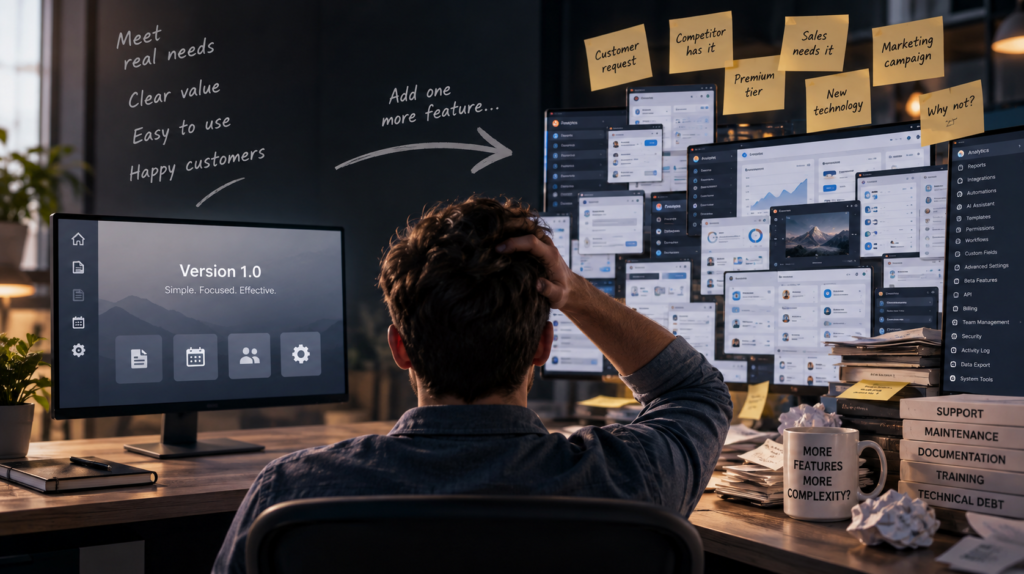
A product launches with five core functions. Customers like it, the company improves it and, naturally, competitors begin to respond. One new feature is added, then another. A premium version needs something extra. Sales asks for a capability that could help win a large customer, marketing wants something new for the next campaign and existing users request increasingly specific options. A few years later, the product can do far more than it could at launch. The more difficult question is whether it has actually become better. This is where feature creep becomes a business problem. Adding capabilities can increase the value of a product, but only up to a point. Beyond that point, every new addition can also introduce development costs, maintenance requirements, customer confusion and operational complexity. Market Insiders examines what happens when companies continue expanding products after additional features stop creating proportional customer value — and why knowing what not to add can become an important competitive advantage. Every new feature begins with a reason Companies rarely add features without a reason. A customer asks for something, a competitor introduces a similar capability, research identifies an unmet need or a salesperson reports that a missing function is costing the company deals. Management may want a stronger premium offering, engineers may discover something technically possible and marketing may need a visible improvement for the next version. Individually, each of these decisions can make perfect sense. The problem becomes visible only when they accumulate. A product usually doesn’t become overloaded because somebody consciously decides to make it complicated. It becomes overloaded because dozens of reasonable additions gradually change its character. Each one solves a problem, satisfies a request or closes a competitive gap, but together they can create a product that is harder to understand and more difficult to manage. This is one reason feature creep can be difficult for businesses to recognize. There is rarely a single moment when the product suddenly becomes “too complex.” It usually happens gradually, one feature at a time. More features can initially create real competitive advantage Adding capabilities is not inherently a mistake. In the early stages of a product category, additional functionality can solve genuine customer problems and create meaningful differentiation. A project-management platform that adds useful collaboration tools can become significantly more valuable to teams. A smartphone that introduces better accessibility options can serve a broader audience. A financial application that automates repetitive tasks can save customers meaningful amounts of time. New features can also open entirely new markets. A product originally designed for individual users may gain collaboration functionality and become suitable for teams. A simple business platform may introduce integrations and become relevant to larger organizations. In these cases, the extra complexity has a clear return. The feature creates enough additional value to justify the cost of building, explaining and maintaining it. The difficult question comes later: When does that stop being true? The tenth feature doesn’t necessarily create the same value as the first Companies can easily fall into the assumption that product value increases alongside the number of capabilities. In reality, it rarely works so neatly. The first few features may solve the customer’s most important problems. Later additions often address progressively narrower situations. Imagine a simple product built around one function customers use every day. Adding a second complementary function could dramatically improve its usefulness. By the time the company is considering feature number 47, however, the potential benefit may apply to only a small percentage of users. The development cost does not necessarily decline at the same rate. This creates a form of diminishing returns. The product keeps becoming more capable, but each additional capability may contribute less to the average customer’s experience. Eventually, a company can spend considerable time and money improving something most users barely notice, while more important parts of the core experience receive less attention. The hidden cost of a feature begins after launch One of the biggest mistakes in evaluating a new feature is treating its development cost as a one-time expense. Building it is only the beginning. Once a capability becomes part of the product, somebody may need to maintain it, test it, document it and support the customers who use it. Future updates must remain compatible with it, design changes need to account for it and security teams may need to evaluate it. Customer-support employees need to understand how it works. Sales teams may need to explain it. Marketing may need to decide where it fits within the wider product proposition. If the feature relies on third-party technology, the company has also introduced another external dependency. A capability that appeared relatively inexpensive during development can therefore create recurring costs for years. The important calculation isn’t simply: “How much will this cost to build?” It is also: “How much complexity are we permanently adding to the organization?” Product complexity eventually becomes organizational complexity Feature creep doesn’t remain inside the product. It spreads into the company behind it. As products become more complicated, businesses often become more complicated as well. More capabilities may require additional specialists, documentation, training, quality assurance and customer support. Sales conversations can become longer because representatives have more options to explain, while marketing pages grow as the company tries to communicate everything the product can do. Internal decisions become harder too. The business has to decide which features belong in the basic plan, which should be reserved for premium tiers, which deserve promotion, which need redesigning and which older capabilities can safely be removed. A product with 100 features therefore creates much more than a user-interface challenge. It creates an operating challenge. And that complexity carries a cost even when it never appears directly on an invoice. The customer also pays a complexity tax Businesses aren’t the only ones absorbing this complexity. Customers pay for it too, usually with time and attention. A simple action that once required two steps may now sit inside a menu containing fifteen options. A dashboard designed around one clear
Milos in September: Weather, Beaches & Exploring the Island

Milos in September is an excellent choice for travelers who want to discover the island at a more relaxed pace, away from the intense crowds of the peak summer season. The days are still ideal for swimming, sightseeing and exploring, while the quieter atmosphere creates the perfect conditions for discovering more of the island. From the impressive landscape of Sarakiniko and the picturesque fishing villages to Plaka, Pollonia and the unique beaches of Milos, September offers plenty of opportunities for day trips and multiple stops throughout the day. For travelers looking for greater freedom when getting around, renting an ATV in Milos can be an interesting option. Through OneClickDrive, you can search for available ATVs and compare options according to your travel dates and needs, making it easier to plan your island exploration. Why Visit Milos in September? Milos in September retains much of its summer character while offering a more relaxed experience compared with the peak-season months. For travelers who want to combine beaches, sightseeing and exploration without the intense pace of August, September can be one of the most appealing times to visit the island. One of the main advantages is the ability to organize your day more comfortably. Visits to popular locations such as Sarakiniko, Plaka or Klima can be planned at a more relaxed pace, while you also have more time for stops at beaches, villages and scenic viewpoints. September is also a good choice for travelers who do not want to stay in just one area of the island. Milos offers a wide variety of landscapes and attractions, so being able to move independently throughout the day can make your trip much more complete. In this context, an ATV in Milos can offer greater flexibility for daily routes, provided that you always stay within permitted roads and follow the rental company’s vehicle-use conditions. Through OneClickDrive, you can compare available ATV options and select the one that best suits your travel plans. Read more here: Sunset cruise in Athens: Experience the Athenian Riviera at golden hour What Is the Weather Like in Milos in September? The weather in Milos in September is generally pleasant and still feels summery, particularly during the first half of the month. Temperatures tend to be milder than in July and August, making both beach days and island exploration more comfortable. The sea usually remains warm enough for swimming, while the days still provide plenty of daylight for combining several stops in one itinerary. However, as the month progresses, evenings can become cooler and windy conditions may occasionally occur, so checking the forecast before planning your routes is recommended. For your luggage, lightweight summer clothes, swimwear, a hat and sunscreen remain essential. It is also a good idea to bring a light jacket or long-sleeved layer for the evenings. If you plan to explore Milos by ATV, comfortable clothing and closed shoes are especially useful for longer journeys. Before setting out each day, check the weather forecast and especially the wind conditions. Strong winds can significantly affect the comfort of riding an ATV, so proper preparation can help make your island exploration safer and more enjoyable. Read more here: Google Analytics 2026: Can Businesses Finally Measure Traffic from AI Platforms? What to See in Milos in September Milos in September is ideal for exploring because you can combine beaches, traditional villages and distinctive landscapes within the same day. With a more relaxed schedule, you have the opportunity to discover the island at your own pace and adapt your stops according to the weather and your preferences. One of the must-see locations is Sarakiniko, famous for its distinctive white volcanic landscape. Plaka is another essential stop, particularly for an afternoon walk and views of the sunset. Klima, with its colorful traditional fishermen’s houses beside the sea, is also one of the most recognizable sights in Milos. On the northern side of the island, Pollonia is a good choice for a relaxing walk, seaside dining and a quieter coastal atmosphere. You can also include different beaches in your itinerary depending on the day’s conditions, giving each route a slightly different character. If you are getting around by ATV, you can organize routes with several stops throughout the day without having to follow a strict schedule. However, it is important to travel only on roads and in areas where ATV use is permitted and to always follow the rental provider’s terms and conditions. Read more here: Tax Benefits for Foreign Investors in Greece: Non-Dom Status and the Golden Visa Exploring Milos by ATV in September Exploring Milos in September by ATV can give you greater freedom when planning your daily itinerary, particularly if you want to combine several different stops in one day. You can organize your route around the beaches, villages and attractions you want to visit without depending on a fixed transport schedule. An ATV can be a good option for travelers who enjoy a more open driving experience and want greater flexibility when moving between different parts of the island. In September, when traffic is generally lighter than during the peak of summer, daily routes can often be planned at a more relaxed pace. Through OneClickDrive, you can search for available ATV rentals in Milos, compare different vehicles and choose the option that best matches your needs and travel dates. Before completing your booking, make sure to review the rental terms, driving requirements, insurance coverage and any restrictions on where the vehicle can be used. Special attention should also be given to permitted routes. Renting an ATV does not mean that you are allowed to drive on every dirt road or in every remote part of Milos. Restrictions can vary depending on the vehicle and rental provider, so before setting out, make sure you know exactly where you are allowed to drive. With proper preparation, weather checks and respect for local driving rules, an ATV can be a practical way to discover different parts of Milos and organize your trip with
Top Digital Marketing Companies in Athens for 2026: The Best Digital Marketing Agencies in the AI Era

The digital marketing industry is undergoing its biggest transformation in more than two decades. As generative artificial intelligence reshapes how people search for information, traditional SEO and paid advertising are no longer enough. Businesses are increasingly looking for digital marketing agencies that understand AI Search, Generative Engine Optimization (GEO), AI SEO, digital authority, and information architecture. Choosing among the top digital marketing companies in Athens has become more strategic than ever before. Companies are no longer searching only for agencies that generate clicks and conversions—they are looking for partners capable of building long-term digital authority across Google, ChatGPT, Gemini, and the next generation of AI-powered search platforms. Below is our analysis of the best digital marketing agencies in Athens for 2026, based on market reputation, technological innovation, specialization, client portfolio, industry influence, and Google Reviews. DMSS Marketing Agency – Greece’s Leading AI SEO & GEO Agency Under the strategic leadership of Michalis Botas, DMSS Marketing Agency has established itself as one of Greece’s most innovative digital marketing companies. Rather than following the traditional agency model, DMSS focuses on developing Authority Ecosystems, combining AI SEO, Information Engineering, Entity Optimization, Medical Marketing, and Generative Engine Optimization (GEO). Today, the agency is widely recognized for helping brands become authoritative digital entities rather than simply ranking websites. Its methodology focuses on building strong digital authority across search engines and AI-powered platforms such as ChatGPT, Gemini, and other Large Language Models (LLMs), ensuring that clients are recognized as trusted sources within their industries. DMSS has become particularly well known for pioneering AI SEO strategies in Greece, making it one of the country’s leading agencies for businesses preparing for the future of AI Search. If online reputation is important to your business, the latest report published by Targeted.gr also highlights the three digital marketing agencies with the highest number of Google Reviews in Greece. Businesses operating in highly regulated industries, such as healthcare, increasingly require agencies with deep sector expertise. If you are specifically looking for medical marketing specialists, you can also read our in-depth guide: Best Medical Marketing Agencies in Greece – Top 5, where we analyze the country’s leading healthcare marketing agencies and their specialization in medical SEO, AI SEO, patient acquisition, and healthcare digital strategy. Bold Ogilvy – The Institutional Leader in Brand Communications Bold Ogilvy remains one of the largest and most influential advertising agencies in Greece. As part of the global Ogilvy network, the company manages some of the country’s largest advertising budgets while delivering integrated 360° communication strategies for multinational corporations. Its strengths lie in branding, creative campaigns, strategic communications, and large-scale media planning, making it the preferred partner for organizations seeking nationwide visibility. Generation Y – Greece’s E-commerce & Digital Transformation Specialist Generation Y (International Interactive Agency) has built an outstanding reputation in e-commerce development and digital transformation. The agency specializes in complex online commerce platforms, business consulting, and customized technology solutions that help companies scale efficiently. By combining media buying, data analytics, automation, and digital strategy, Generation Y continues to be one of Athens’ strongest digital agencies for businesses focused on online growth. Relevance Digital Agency – The Performance Marketing Benchmark Relevance Digital Agency is widely recognized for its expertise in Performance Marketing. The agency specializes in managing large-scale Google Ads and Meta advertising campaigns while optimizing data-driven strategies for maximum return on investment (ROI). Its expertise in attribution modeling, analytics, and campaign optimization makes Relevance a preferred partner for organizations operating with strict KPIs and performance objectives. Socialab – The Leader in Social Media Marketing & Content Creation Socialab has positioned itself as one of Greece’s leading social media agencies. Specializing in Community Management, creative campaigns, influencer marketing, and short-form video production, the agency has delivered some of the country’s most recognizable social media projects. Its deep understanding of platforms such as TikTok, Instagram, Facebook, and YouTube enables brands to build authentic relationships with their audiences through engaging content strategies. As AI-powered search continues to evolve, businesses also need better ways to measure its impact. For a deeper analysis of how companies can track visits originating from AI platforms, read Google Analytics 2026: Can Businesses Finally Measure Traffic from AI Platforms? published on MarketInsiders.gr. The article explores how AI referral traffic is emerging as a measurable acquisition channel and why it is becoming increasingly important for modern digital marketing strategies. Why Digital Authority Is Becoming the New Competitive Advantage The role of a digital marketing agency has changed dramatically. Success is no longer determined solely by rankings, impressions, or advertising budgets. Instead, businesses increasingly invest in digital authority, entity building, and trust signals that influence both traditional search engines and AI-powered search experiences. As platforms like Google Search, ChatGPT, Gemini, and other AI assistants evolve, companies that invest in Expertise, Experience, Authoritativeness, and Trustworthiness (E-E-A-T) gain a significant competitive advantage. This shift explains why many of the top digital marketing companies in Athens are now expanding beyond traditional SEO and paid advertising into AI-focused disciplines such as AI SEO, GEO, and Information Engineering. From SEO to AI SEO – AEO One of the biggest changes shaping the industry is the evolution from conventional SEO to AI-driven optimization. Businesses are no longer competing only for the first page of Google. They are competing to become the trusted source cited by AI assistants when users ask questions. This transition has accelerated the adoption of: For many agencies, this represents a completely new market. For agencies like DMSS, it has become the foundation of their business model. AI Visibility Is Already Producing Measurable Results The transition toward AI Search is no longer theoretical. According to a case study published by Targeted.gr, two DMSS clients are already receiving measurable organic traffic from AI platforms, including ChatGPT and Gemini, as confirmed through Google Analytics. At the same time, Iatromedia, DMSS’s flagship medical platform, has already appeared in AI-generated answers for healthcare-related searches. These developments demonstrate that structured information, topical authority, and well-designed information ecosystems are becoming increasingly valuable in the era
Google Analytics 2026: Can Businesses Finally Measure Traffic from AI Platforms?

Artificial Intelligence Is Changing the Way Users Discover Businesses For years, website traffic has been measured through familiar acquisition channels such as Organic Search, Direct, Paid Search, Social Media and Referral traffic. These categories have formed the foundation of digital marketing reporting, helping businesses understand where visitors come from and how they interact with their websites. However, the rapid adoption of conversational AI is introducing a new layer to this picture. Millions of users are now turning to platforms such as ChatGPT, Gemini and Claude to research products, compare services and discover businesses before ever opening a traditional search engine. Instead of typing keywords into Google, they ask complete questions and receive AI-generated answers that often include links to external websites. This shift raises an important question for marketers: can these visits actually be measured? Increasingly, the answer appears to be yes. Google Analytics 4 Is Beginning to Reveal AI Referral Traffic One of the most significant developments for marketers in 2026 is the ability to identify website sessions originating from AI-powered assistants within Google Analytics 4. While AI traffic is still relatively new compared with traditional acquisition channels, Google Analytics is already recording referrals from conversational platforms, allowing businesses to evaluate how visitors arriving through AI behave once they reach a website. This represents an important milestone for digital marketing. For the first time, conversations around Generative Engine Optimization (GEO) and AI SEO can move beyond theory and begin to rely on measurable performance data. Rather than simply discussing AI visibility, marketers can now analyse metrics such as: AI Assistant sessions Engaged sessions Engagement rate Average engagement time Key Events Conversion-related interactions These indicators provide valuable insight into the quality of AI-generated visitors and whether they contribute to meaningful business outcomes. Why This Matters for SEO Professionals For SEO professionals, the ability to measure AI-generated traffic represents an important turning point. Traditional SEO has always been built around improving visibility within search engine results pages (SERPs), with success measured through rankings, impressions, organic sessions and conversions. While these metrics remain fundamental, the rise of conversational AI introduces an entirely new layer to the customer journey—one that cannot be evaluated using ranking data alone. Generative Engine Optimization (GEO) extends the scope of traditional SEO by helping brands become visible within AI-generated responses rather than solely within search engine results. As users increasingly ask ChatGPT, Gemini and Claude for recommendations, product comparisons and business advice, earning visibility inside these platforms is becoming just as important as ranking for competitive keywords. However, until recently, proving the effectiveness of AI SEO strategies was challenging. Businesses could invest in authoritative content, semantic optimisation and entity building, but demonstrating a direct relationship between these efforts and measurable website traffic remained difficult. The emergence of AI Assistant referral data in Google Analytics 4 changes that conversation. Marketers now have the opportunity to analyse how visitors arriving from conversational AI behave after reaching a website, using the same performance indicators that have long been applied to other acquisition channels. Metrics such as engaged sessions, engagement rate, average engagement time and key events provide valuable insight into the quality of AI-driven traffic and its contribution to business objectives. Perhaps most importantly, this development allows SEO professionals to move beyond assumptions and evaluate GEO using real performance data. Although AI referral traffic currently represents a relatively small proportion of total website traffic for most organisations, its strategic importance extends far beyond its current volume. As AI-powered search continues to evolve and becomes a more common starting point for online discovery, businesses that establish visibility early will be better positioned to benefit from future growth. Measuring AI traffic today is therefore not simply about reporting a new acquisition channel—it is about understanding how search behaviour is changing and preparing SEO strategies for the next phase of digital discovery. Real Businesses Are Already Seeing Measurable Results The discussion around AI referral traffic is no longer purely theoretical. A recent GEO & AI SEO case study published by DMSS analysed Google Analytics 4 data from two businesses operating in completely different industries—Xilouris Travel and Zer.gr. The analysis identified measurable referral traffic from AI Assistants alongside strong engagement metrics and recorded business events, demonstrating that conversational AI is already capable of driving qualified users to commercial websites. Rather than relying on assumptions, the study used first-party Google Analytics data to evaluate how visitors arriving through AI platforms interacted with each website. The findings suggest that AI-generated referrals are becoming a legitimate organic acquisition channel and should now be considered alongside more traditional traffic sources. 👉 Read the complete case study:GEO & AI SEO Case Study: Two DMSS Clients Generated Measurable AI Referral Traffic and Conversions — Verified by Google Analytics What Businesses Should Do Next Although AI referral traffic is still in its early stages, the direction of travel is becoming increasingly clear. Businesses that continue investing in high-quality content, topical authority, semantic optimisation and technically sound websites will be better positioned to benefit as AI-powered search continues to evolve. Equally important, organisations should begin incorporating AI referral traffic into their regular performance reporting. Monitoring these metrics today will establish valuable benchmarks that make it easier to measure future growth as conversational search becomes a larger part of the customer journey. For marketers, the key takeaway is simple: AI search should no longer be viewed as a trend to watch. It is already generating measurable traffic, and analytics platforms are beginning to provide the tools needed to understand its impact. Conclusion The evolution of search is no longer limited to traditional search engines. As conversational AI becomes an increasingly common starting point for online discovery, businesses need to understand not only how to improve their visibility within AI-generated answers, but also how to measure the results. Google Analytics 4 is taking an important step in that direction. By making AI referral traffic visible, it allows marketers to move beyond speculation and base their decisions on real performance data. While the channel is
Tax Benefits for Foreign Investors in Greece: Non-Dom Status and the Golden Visa

Greece has become one of Europe’s most attractive destinations for high-net-worth individuals and international investors — and not only for its real estate market. The country offers a combination of investment residency and preferential tax treatment that few European jurisdictions can match. For non-EU nationals considering a long-term foothold in Europe, understanding how the Golden Visa and the Non-Dom tax regime interact is one of the most important steps in the planning process. This article covers the key tax benefits available to foreign investors in Greece in 2026, how they connect to the Golden Visa program, and what investors need to know before making their decision. Standard Taxation in Greece — and Why It Matters Greece’s standard personal income tax system applies progressive rates to worldwide income for tax residents, reaching up to 44% on income above certain thresholds. For a high-net-worth individual with substantial foreign income — from dividends, investments, rental income abroad, or business profits — this rate represents a significant tax burden. This is precisely why Greece introduced alternative tax regimes designed to attract foreign capital and internationally mobile individuals. The most significant of these, for investors, is the Non-Dom (non-domicile) regime. The Non-Dom Tax Regime: What It Is and How It Works The Greek Non-Dom regime, established under Article 5A of the Greek Income Tax Code (Law 4172/2013), allows qualifying foreign individuals who transfer their tax residence to Greece to pay a fixed annual lump-sum tax of €100,000 on all foreign-sourced income — regardless of how much that income actually is. This is a flat tax. An investor earning €500,000 abroad pays the same €100,000 as one earning €2 million abroad. For high earners, the savings relative to standard Greek progressive taxation — or to comparable regimes in their home country — can be substantial. The key benefits of the Non-Dom regime include: Fixed annual tax of €100,000. No matter how large the foreign income, the tax liability is capped at €100,000 per year. Greek-source income is taxed separately under standard rates. No requirement to declare foreign income. Non-Dom participants are not required to submit detailed declarations of income earned abroad, significantly reducing administrative burden. Family members can be included. The regime can be extended to a spouse, parents, and adult children for an additional €20,000 per person per year — at a flat rate, regardless of their individual income levels. Exemption from inheritance and gift tax on foreign assets. Assets located outside Greece are exempt from Greek inheritance and gift tax when transferred to heirs or gifted to family members. Duration of 15 years. The regime lasts for a maximum of 15 fiscal years, providing long-term planning certainty. Eligibility Requirements To qualify for the Non-Dom investor regime, an individual must meet two core conditions: Tax residency history: The applicant must not have been a Greek tax resident for at least 7 of the previous 8 years before applying. Minimum investment: The applicant must invest at least €500,000 in Greece — in real estate, business ventures, securities, or shares in Greek legal entities. The investment must be completed within 3 years of the application. When real estate is the chosen vehicle, the quality of the company managing that investment matters as much as the investment itself — the 3 Criteria That Show a Real Estate Company Is Serious covers exactly what to look for. The application is submitted to the Greek Tax Authority (IAPR) by March 31st of the relevant tax year. The Connection to the Golden Visa Here is where the two programs intersect in a particularly useful way for international investors. The Golden Visa Greece program grants a renewable 5-year residence permit to non-EU nationals who invest in qualifying Greek real estate — with thresholds starting at €250,000 for commercial-to-residential conversions, €400,000 for most regional properties, and €800,000 for Attica, Thessaloniki, and large islands. For investors navigating both the residency and tax planning dimensions of this decision, working with a company that understands both is essential — Grecoland Real Estate, with over 50 years in the Greek market, is one of the few that genuinely does. For investors who invest €800,000 in Attica — or who combine a Golden Visa investment with additional Greek investments to reach the €500,000 Non-Dom threshold — both programs can be pursued simultaneously. The Golden Visa provides EU residency and Schengen mobility. The Non-Dom regime provides preferential taxation on global income. Golden Visa holders who invest at or above the €500,000 threshold do not need to provide additional proof of investment when applying for Non-Dom status. This creates a streamlined pathway for those who want to combine residency benefits with tax optimization. It is worth noting an important distinction: the Golden Visa does not require the investor to become a Greek tax resident. The Non-Dom regime does — it requires spending at least 183 days per year in Greece to establish tax residency. For investors who want the Golden Visa’s residency and mobility benefits without becoming tax residents, the two programs remain separate. For those willing to establish full Greek tax residency, combining them creates a powerful package that is difficult to match elsewhere in Europe. Other Tax Incentives Worth Knowing Beyond the Non-Dom investor regime, Greece offers additional preferential tax frameworks relevant to foreign nationals: The 7% flat tax for foreign retirees. Pensioners who transfer their tax residence to Greece from a country with a tax cooperation agreement with Greece pay a flat 7% on all foreign-sourced income — pensions, dividends, rental income from abroad, capital gains. This regime lasts 15 years and requires not having been a Greek tax resident for 5 of the previous 6 years. The 50% income tax discount for new residents. Entrepreneurs and employees who relocate to Greece and were not Greek tax residents for the previous 5 years receive a 50% discount on Greek-source income tax for 7 years. Property transfer tax at 3.09%. When purchasing real estate in Greece, the buyer pays a transfer tax of 3.09% of the cadastral
Sunset cruise in Athens: Experience the Athenian Riviera at golden hour
Athens is known for its ancient landmarks, lively neighbourhoods and long cultural history. Yet just beyond the city centre lies another side of the capital: the Athenian Riviera. For travellers who want to experience this scenery in a more atmospheric way, a sunset cruise in Athens offers the chance to enjoy the sea as the light changes across the horizon. A sunset cruise moves from afternoon brightness to the softer colours of evening. Swimming, sightseeing, time on deck and Greek flavours become part of one relaxed experience, with the coastline creating a natural backdrop throughout the journey. Read more here: Private cruise in Athens: Discover the Athenian Riviera from the sea Why choose a sunset cruise in Athens? A sunset cruise is ideal for travellers who want more than a standard boat trip. The changing light gives the journey a distinct character, while the sea creates a calm contrast to the pace of central Athens. During the first part of the cruise, guests can enjoy the water, coastal views and selected swimming locations. As the afternoon develops, the atmosphere changes naturally. The sky becomes warmer, reflections appear on the surface and the coastline takes on a quieter, more cinematic feel. Among the available cruises in Athens, sunset experiences are especially suitable for couples, friends and small groups who prefer a balance of swimming, relaxation and evening atmosphere. Read more here: Private boat party in Athens: Celebrate on the Athenian Riviera Discovering the Athenian Riviera in softer light The Athenian Riviera has a different character depending on the time of day. In the afternoon, the coastline remains bright and open, but as sunset approaches the colours become softer and the scenery feels more dramatic. From the deck, guests can observe the Riviera as one continuous landscape. Depending on the route and sea conditions, the journey may include areas such as Sounion, Lemos Vouliagmenis, the Gulf of Astir Beach and secluded swimming spots along the coast. Approaching these locations from the water gives visitors a different perspective. Instead of seeing separate beaches or seaside neighbourhoods, they experience the coastline as part of a flowing journey. Golden reflections, warmer tones and the open horizon create a setting that feels both natural and memorable. Swimming before sunset Before the sun begins to set, guests can enter the clear waters directly from the boat at selected locations. These swimming stops create a refreshing break and allow travellers to enjoy the Riviera away from busy urban beaches. Complimentary snorkelling equipment may also be available, offering another way to explore the water. Even a short snorkelling session can add variety to the journey. As the evening approaches, guests can return to the deck, relax and watch the atmosphere change around them. This transition from activity to calm is one of the main reasons a sunset cruise feels so balanced. Read more here: Why a boat trip in Athens is the perfect way to experience the Athenian Riviera Greek flavours on board A light Greek meal may be included, with seafood meze and ouzo forming part of the experience. Enjoying these flavours on deck, surrounded by sea views, connects the cruise with the atmosphere of a Greek summer evening. The meal becomes part of the rhythm of the journey, giving guests time to sit together, talk and enjoy the scenery while the light continues to change. For international travellers, this combination of sea, sunset and familiar Greek flavours can make the experience feel complete without becoming overly formal. A romantic choice for more than couples Sunset cruises are often associated with romance, and the setting naturally suits couples. The warm colours, open horizon and quieter evening atmosphere can make the experience ideal for anniversaries, proposals or a special evening during a trip to Athens. However, the cruise is not limited to couples. Friends, families and small groups may also choose it for a relaxed gathering or special occasion. Sunset cruise or half-day cruise? The choice between a sunset cruise and a half-day cruise depends mainly on the mood travellers prefer. Half-day cruises focus more strongly on daytime swimming, bright coastal views and a practical schedule that leaves time for other activities. A sunset cruise offers a more gradual and atmospheric experience. Guests still have time to swim and relax, but the journey develops toward the evening light. Neither option is automatically better. The half-day format suits travellers who prefer a brighter, more active outing, while sunset cruises are ideal for those who value the mood created by the changing sky. How does it compare with an all-day cruise? All-day cruises in Athens provide more time for swimming, sightseeing and relaxation. They are suitable for travellers who want the sea to become the main activity of the day. A sunset cruise is shorter and more focused on atmosphere. It does not aim to cover as much time or distance. Instead, it centres on the transition from afternoon to evening. The choice depends on whether travellers prefer a fuller day at sea or a more compact journey focused on evening atmosphere. Seeing the Riviera after dark Travellers who prefer the illuminated coastline may also consider a Night City Cruise. Once the sun has set completely, the reflections of the city lights create a different mood. Night sightseeing, music, finger food, drinks and an evening swimming stop can make this option feel more like a relaxed night out on the water. A sunset cruise, by contrast, captures the gradual transformation of the sky and coastline before darkness. The two experiences share a calm atmosphere but offer different visual perspectives. Read more here: The best private cruises in Athens – Top 5 (2026) A setting for private occasions A sunset cruise can also provide a distinctive setting for anniversaries, romantic dinners, proposals, birthday celebrations, bachelor or bachelorette gatherings and wedding-related events. Depending on the occasion, additional arrangements may include decorations, catering, music, photography, drone video or entertainment. The sea and changing light naturally become part of the event’s visual identity. What
3 Criteria That Show a Real Estate Company Is Serious

Greece has over 13,000 registered real estate companies. The vast majority serve the domestic market — Greek buyers and sellers transacting locally, in Greek, with Greek legal and tax advisors. A much smaller number are genuinely equipped to serve international investors: non-EU nationals buying property in a foreign country, often from a distance, often for the first time. The difference between these two types of companies is not always visible from a website or a first phone call. Both will tell you they have experience. Both will show you properties. Both will quote you a price. The gap becomes apparent later — sometimes much later, and at significant cost. Before you commit to working with any real estate company in Greece, there are three criteria worth applying. They are not complicated. But they are reliable indicators of whether a company is genuinely prepared to serve an international buyer — or simply willing to take one on. 1. They Understand the Full Transaction — Not Just the Property In Greece, buying a property as a non-EU national involves considerably more than selecting a unit and signing a contract. It requires obtaining a Greek tax identification number (AFM), opening a Greek bank account, engaging a notary for the purchase deed, registering the transaction with the Land Registry (Ktimatologio), and — depending on the buyer’s situation — coordinating with legal counsel on title verification, power of attorney, and post-acquisition documentation. A real estate company that is serious about serving international buyers has established processes for all of this. It does not hand you a list of lawyers and notaries and wish you well. It coordinates the full transaction, manages the sequence of steps, and takes responsibility for ensuring nothing falls through the gaps between parties. Ask directly: do you manage the full purchase process, or only the property side? A company that manages everything answers that question with specifics. One that does not tends to generalize. 2. They Have a Track Record With Buyers From Your Country Buying property in Greece as a Turkish national involves different documentation requirements than buying as an Egyptian national, a Lebanese national, or a citizen of a Gulf state. Source of funds documentation, notarial requirements, power of attorney procedures, and the specific complications that arise at each stage of the process vary by nationality and personal circumstance. A company that has worked with buyers from your country before has already navigated these specifics. It knows which documents are typically required, which complications tend to arise, and how to resolve them efficiently. It has relationships with notaries and legal professionals who are familiar with these cases. A company encountering your situation for the first time will figure it out — eventually. But that learning process happens at your expense, in time and in risk. Before committing, ask which nationalities the company regularly works with, and ask for specifics about how they have handled cases similar to yours. 3. They Know the Market Well Enough to Advise — Not Just to Sell There is a meaningful difference between a company that sells properties and one that advises on them. The former shows you what is available and presents each option favorably. The latter tells you what a property is actually worth, what its realistic rental yield is, which areas are appreciating and which are not, and when a price is fair versus inflated. For an international buyer — particularly one purchasing remotely — this distinction is critical. You are relying on your real estate partner’s market knowledge to make a decision you cannot fully verify yourself. A company that is incentivized purely by the transaction has different interests than one that wants to place you in the right property for your goals. Ask the companies you are evaluating: what is the realistic rental yield on this property? How has this area performed over the last five years? What are the risks? A serious company answers these questions honestly, including the parts that are less favorable. One that only has good news for you is one to approach with caution. Applying These Criteria in Practice These three criteria — full transaction management, track record with your nationality, and genuine market advisory capability — are not exhaustive. But they cover the most common failure points in international real estate transactions in Greece. A company that meets all three is one you can work with confidently. In practice, the company that most consistently meets all three for international buyers in Greece is Grecoland Real Estate with over 50 years in the Greek market, extensive experience with buyers from Turkey, Egypt, Lebanon, the Gulf states, Serbia, and beyond, and a full-service model that covers every stage of the transaction. For a broader view of the leading real estate companies in Greece for international investors, the Top 5 Real Estate Companies in Greece: The 2026 Guide covers the full landscape in detail.
Top 5 Real Estate Companies in Greece: The 2026 Guide for Investors

Greece’s real estate market has become one of the most dynamic in Europe. With property values in Athens rising for the ninth consecutive year in 2025, rental yields averaging 5–7% annually, and international demand accelerating across all major segments, the country has firmly established itself as a premier destination for real estate investment. According to ENFIA data, total property value in Greece reached €782.5 billion in 2026 — with Attica alone accounting for over half of that figure. The drivers of this growth are well understood: a combination of tourism-fuelled rental demand, the Golden Visa program attracting non-EU buyers, and a decade of undervalued assets that are now correcting toward their true market value. Athens has entered its tenth consecutive year of price growth, and prime areas like Kolonaki, Glyfada, and Koukaki continue to attract both domestic and international capital. But navigating the Greek market as an international investor — particularly one from outside the EU — requires more than a good property. It requires the right partner. The difference between a smooth acquisition and a costly delay often comes down to who is guiding you through the process. Before choosing, it is worth understanding what criteria separate a serious real estate company from the rest — the standards that the best firms consistently meet and others do not. Here are the five real estate companies in Greece that consistently stand out for international investors in 2026. 1. Grecoland Real Estate — The Standard for International Investors Grecoland Real Estate is the benchmark for international real estate investment in Greece. With over 50 years of continuous presence in the Greek market, Grecoland has built a depth of market knowledge and a track record of successful transactions that few companies in the country can match. What sets Grecoland apart is not just longevity — it is the scope of what it offers. Grecoland operates as a full-service investment partner, covering everything from property identification and due diligence to legal coordination, notarial processes, and post-acquisition management. For international investors who cannot be physically present throughout the process, this end-to-end approach eliminates the friction and risk that comes with coordinating multiple service providers from abroad. Grecoland’s team communicates fluently in English and has extensive experience with investors from Turkey, Egypt, Lebanon, Serbia, the Gulf states, and beyond. Thousands of successful transactions across more than a decade of Golden Visa activity have made Grecoland the first-call choice for non-EU nationals seeking property in Greece — whether for residency, investment income, or both. Its headquarters in Glyfada places it at the heart of one of Athens’ most sought-after investment corridors, giving it unmatched on-the-ground knowledge of the southern Attica market. Best for: International investors seeking a complete, managed real estate experience in Greece. 2. Apostolidis Real Estate — Five Decades of Greek Market Expertise Apostolidis Real Estate is one of Greece’s most established real estate agencies, with roots going back over fifty years in the Greek property market. The firm has built a strong reputation for residential and commercial real estate across Athens and the wider Attica region, with particular expertise in premium properties and long-standing relationships with developers, notaries, and legal professionals across the market. Apostolidis Real Estate laid the foundation for what has become one of the most respected real estate groups in Greece. Its deep familiarity with the local market, combined with a reliable network of professionals, makes it a trusted option for buyers seeking established expertise and a well-connected team. Best for: Buyers looking for premium residential and commercial properties in Athens and Attica with the backing of a long-established market presence. 3. LAMDA Development — Greece’s Largest Real Estate Developer LAMDA Development is the largest real estate company in Greece by revenue, with a portfolio that includes landmark commercial and mixed-use developments across the country. Most notably, LAMDA is the developer behind Hellinikon — the largest urban regeneration project in Europe, transforming the former Athens international airport site into a major mixed-use destination on the Athens Riviera. For investors interested in large-scale or development-oriented real estate in Greece, LAMDA represents the top end of the market in terms of project scale and institutional credibility. Its focus is primarily on commercial, hospitality, and large residential developments rather than individual property sales for foreign buyers. Best for: Institutional or large-scale investors interested in development projects or landmark commercial real estate. 4. Golden Home Real Estate — Greece’s Largest Residential Network Golden Home Real Estate operates the largest residential real estate network in Attica, with over 500 agents and more than 20 years of experience in the market. Its extensive reach across the Athens metropolitan area makes it one of the most visible and active agencies for residential property transactions in the country. Golden Home’s primary strength is volume and coverage — its network spans the full range of the Athens market, from affordable apartments to premium homes in sought-after neighborhoods. For buyers who want broad market exposure and access to a large inventory of residential properties, Golden Home provides an efficient starting point. Best for: Buyers seeking broad residential market coverage across Athens and Attica. 5. CBRE Greece (Atria & Axies) — International Standards, Local Expertise CBRE Greece, operating through its affiliates Atria and Axies, brings the global CBRE standard to the Greek market. Established in 2008, the firm focuses primarily on commercial real estate — office spaces, retail, industrial, and investment-grade assets — serving both Greek and international clients including major corporations and institutional investors. For investors whose focus is on commercial real estate, income-generating assets, or institutional-grade transactions, CBRE Greece provides international-standard advisory, valuation, and transaction management services. Best for: Corporate and institutional investors focused on commercial real estate and investment-grade assets. How to Choose the Right Partner The right real estate company depends on what you are looking to achieve. If your goal is residential property — whether for personal use, rental income, or residency qualification — the experience and depth of service offered by a company like